
30 BDSM Safewords and How to Pick Yours
Published 8 min read
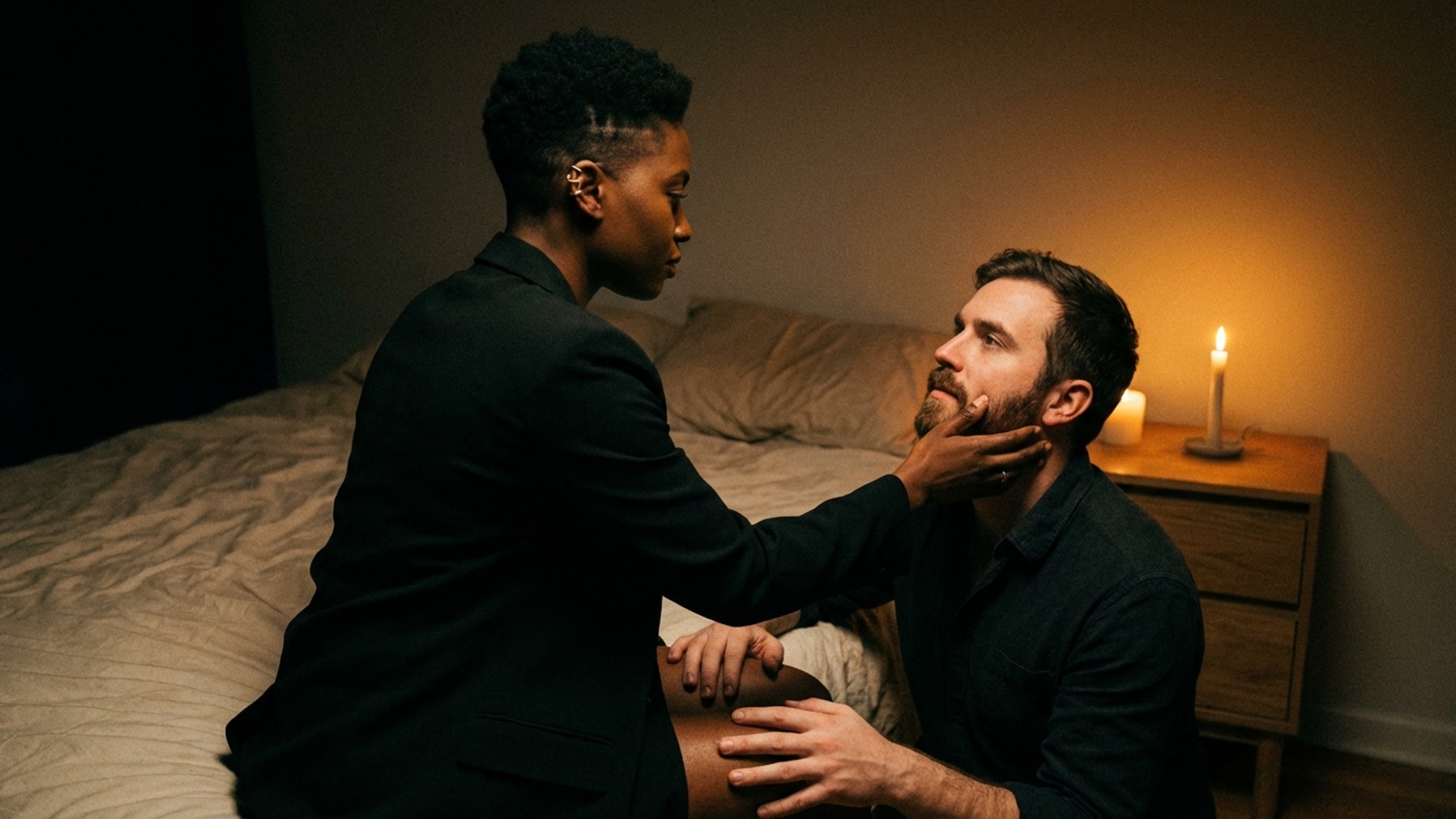
A safeword only does its job if you can remember it under pressure and your partner recognizes it the instant you say it. The 30 below are working examples that real practitioners use, grouped into the categories most people pick from. Pick what fits your style. The full how-to is in the safewords guide. The list is here.
The Stoplight Safeword System (Red, Yellow, Green)
Most public play spaces and community events default to the stoplight. Knowing it is table stakes if you ever play in a dungeon, at a kink event, or with a partner who is new to you.
Red ends the scene. The dominant puts down implements, releases restraints, and shifts into aftercare. There is no negotiation with red.
Yellow asks for a change. Something needs to adjust but the scene does not need to end. Maybe a rope is hitting a nerve. Maybe the intensity is climbing past where the bottom wants to be. Yellow gives partners a chance to recalibrate before red.
Green confirms continue. Dominants often check in by asking “color?” and listening for the answer. A clear green confirms the current direction is working.
You can use the stoplight by itself, swap in custom words that map to the same three levels, or stack a custom word on top of the stoplight for redundancy. Whatever the labels, the three-tier structure is what makes it work.
How to Pick a Safeword That Actually Works
Three rules cover most of what matters. The deeper treatment is in the safewords guide; this is the short version.
1. Pick something distinctive. A safeword should be a word you would never say during a scene. “Pineapple,” “Oklahoma,” and “encyclopedia” are classic precisely because they break the immersion. Avoid anything that sounds like a moan, a plea, or anything you might actually say during intense play.
2. Keep it short. One or two syllables is the sweet spot. You need to say it when you are out of breath, disoriented, or deep in subspace. Three syllables is the upper limit for most people under physical stress.
3. Make sure it cannot be confused with permission. Test it out loud with your partner. If your safeword could be mistaken for “more,” “harder,” or anything that signals “keep going,” pick a different one.
Now to the list.
Classic Kink-Community Safewords
These are the words you will hear at public events and in community education. If you only memorize five safewords, memorize these.
1. Red
The stoplight stop. Universal across the kink community and the only safeword you can assume any experienced player already knows. Works everywhere from your bedroom to a public dungeon. Fails only if the bottom cannot speak at all, which is where non-verbal signals come in.
2. Yellow
The stoplight slow-down. Lets the scene continue with adjustments instead of forcing a full stop. Works because it gives both partners an out before they hit red. Fails when the bottom treats it as optional and skips straight to red, losing the de-escalation step.
3. Green
The stoplight go-ahead. Best used as a response to a top’s “color?” check-in. Works as an active feedback loop that keeps the dominant calibrated to the bottom’s state. Fails if the bottom answers reflexively without actually checking in with themselves first.
4. Pineapple
The iconic non-stoplight standard. Distinctive, two syllables, sounds nothing like a moan. Works as a personal safeword for couples who want something memorable outside the stoplight system. Fails in any scene that already includes food play.
5. Banana
A close cousin of pineapple, equally easy to remember, equally hard to confuse with anything sexual. Works for partners who want a stop word with personality. Fails for couples who find the silliness breaks immersion more than they want.
Random Single-Word Safewords
Pulling a one-off noun from outside the scene works because the word has no kink association. Pick something easy for you to say and easy for your partner to recognize.
6. Vermont
Short, sharp, almost never spoken in a kink context. Works because no one moans the name of a New England state. Fails only if one of you is from there and uses it conversationally.
7. Encyclopedia
Five syllables is the upper limit, but encyclopedia hits hard precisely because it is so out of place. Works as a “I really mean it” word. Fails as a fast yellow because the length costs you speed.
8. Helicopter
Three syllables, sharp consonants, easy to project. Works because the punchy K-sound carries through loud play. Fails only if either of you finds the imagery distracting in the moment.
9. Mango
Two syllables, soft, easy to whisper. Works when the bottom is too overwhelmed to project. Fails if either partner finds it too cute to take seriously the first time it actually comes up.
10. Avocado
Distinctive, easy to say even when out of breath. Works as a stop that feels playful rather than clinical. Fails if either of you says it often in non-kink contexts, like during weekly grocery planning.
Food Safewords
Food words stay popular because they are concrete, neutral, and almost impossible to misuse in a sexual context. The trick is picking one you do not say often enough to dilute its meaning.
11. Watermelon
Four syllables but memorable because the rhythm is unique. Works as a “this is serious” word. Fails as a fast yellow because the length slows you down right when you want speed.
12. Asparagus
Four syllables, hard consonants, sounds nothing like anything you might say in bed. Works because no one fakes their way into saying asparagus mid-scene. Fails for the same reason as watermelon: it is long.
13. Marshmallow
Three syllables, soft, easy to say even when whispering. Works for scenes where the bottom needs a gentle-feeling stop word. Fails for partners who want something with more punch.
14. Cinnamon
Three syllables, distinctive consonants, easy to project. Works as a clean “this is over” word. Fails if either of you uses it pet-name style outside scenes and it starts blending in.
15. Tofu
Two syllables, weirdly punchy. Works for couples who want a safeword that sounds like a joke until it is needed. Fails if the silliness gets in the way the first time you have to actually use it.
Place-Name Safewords
Place names work because they are mentally distinct from everything happening in the scene. The kink community has used them for decades.
16. Oklahoma
The classic place safeword. Four syllables, easy to project, completely outside any sexual context. Works as the gold standard for couples who want something other than stoplight. Fails only if one of you grew up there and the word feels too domestic.
17. Saskatchewan
Five syllables, but the cadence is so specific it cuts through anything. Works as an unambiguous “this is real” word. Fails for the same reason as encyclopedia: the length costs you speed when you need it.
18. Mongolia
Four syllables, soft start, sharp end. Works because the rhythm is so unusual nothing else gets confused with it. Fails only in households where geography podcasts run as background noise.
19. Reykjavik
Three syllables, sharp consonants, weirdly memorable. Works for couples who like a safeword that feels like a private code. Fails if either of you struggles to pronounce it cleanly under stress.
20. Tahiti
Three syllables, easy to say, easy to recognize. Works as a softer stop word for couples who want gentleness baked in. Fails only if you have actually traveled there together and the word loses its strangeness.
Pop-Culture and Unusual Safewords
Names from books, shows, or fandoms work because the word triggers a mental shift. The catch is that both partners need to know the reference and find it pulled from far enough outside the scene to break frame.
21. Voldemort
Three syllables, instantly recognizable, almost never said in a sexual context. Works as a “this is genuinely over” word. Fails if you say it constantly during Harry Potter rewatches.
22. Rivendell
Three syllables, lyrical, completely out of place in any scene. Works for Tolkien-aware couples. Fails as a quick yellow because the lyrical sound can feel ambiguous in the heat of the moment.
23. Galactica
Four syllables, sharp K-sound, easy to project. Works for sci-fi fans who want a safeword with personality. Fails if neither of you actually knows the reference, because the word then feels assigned rather than chosen.
24. Aslan
Two syllables, soft, easy to whisper. Works as a gentle stop. Fails if you read the Narnia books at bedtime and the word starts feeling tangled up in daily life.
25. Hodor
Two syllables, weirdly punchy, instantly memorable. Works for Game of Thrones fans. Fails if you cannot say it the first time without laughing.
Non-Verbal Safeword Signals
Verbal safewords stop working the moment the bottom cannot speak. Gags, deep subspace, face-down positions, and breath play all need a non-verbal backup. These are the most reliable.
26. Drop the ball
Hold a tennis ball, set of keys, or other small object in one hand. Letting go means red. Works because it requires no conscious effort; the hand simply relaxes. Fails if the bottom’s hand is restrained behind their back or otherwise not free to drop.
27. Three rapid taps
Tap any reachable surface three times. Works for scenes where the bottom’s hand is mostly free. Fails if the top is not in a position to see or hear the taps clearly, especially during loud play.
28. Closed fist
Open palm means green, flat hand means yellow, closed fist means red. Works because the visual gradient is unmistakable. Fails if the top cannot consistently see the bottom’s hand throughout the scene.
29. Squeaky toy
A small squeaker held in one hand. A single squeeze means red. Works because the sound cuts through ambient noise. Fails if the toy gets dropped without being squeezed, which happens easily during intense bondage.
30. Dog training clicker
A clicker held in one hand. One click means red. Works because the sound is sharp, unmistakable, and very hard to ignore. Fails if the bottom’s hand goes limp and the click never happens.
Stack One Verbal and One Non-Verbal
The strongest safeword system is two systems. Pick one word and one non-verbal signal. Practice both when you are not in a scene. Make sure the top can recognize each one from different positions. This redundancy is what catches the edge cases where a single verbal safeword would fail.
Negotiate your safewords during scene planning, document them in your Dom/sub agreement, and revisit them as your dynamic grows. Safewords evolve. The first version you agree on at the start of a relationship rarely survives a year of real practice, and that is the point. The agreement keeps pace with the dynamic.
Share
FAQ
Frequently asked.
- Should the dominant have a different safeword than the submissive?
- Most experienced couples keep them the same for simplicity, and that is fine. Using different words is also fine. The point is that both partners need a safeword and both partners need to be able to call one without hesitation. Tops get overwhelmed too, hit emotional triggers, or realize a scene has moved past their own comfort. Safewords protect both people in the room.
- Can you change your safeword between scenes or partners?
- Yes. A safeword is a tool for a specific scene with a specific partner. Different partners often use different words. Some couples rotate between a few they all know. The important part is that everyone in the current scene agrees on what the current safewords mean before play starts.
- What happens if you forget your safeword in the middle of a scene?
- Say anything that breaks the immersion. "Stop." "Wait." Your real name. Many people end up saying "actually" because it is so conversational. A top who cares about consent will pause for any of those and ask "what color?" or "do you need to stop?" Forgetting the specific word is not a system failure. The system is whatever cuts through and gets the scene paused.
- Is it OK to use "safeword" itself as your safeword?
- It works for plenty of couples. The word is short, unmistakable, and impossible to confuse with anything else mid-scene. The only downside is that some partners want a word that feels personal to their dynamic rather than a generic label. Either choice is valid.
Sources
- Wiseman, J. (1996). SM 101: A Realistic Introduction (2nd ed.). Greenery Press.Community foundational text on safeword culture and the stoplight framework.
- Easton, D., & Hardy, J. W. (2017). The Ethical Slut (3rd ed.). Ten Speed Press.On consent and communication practices that safewords sit inside.
Related
- guides
BDSM Safewords: How to Choose, Use, and Honor Them
- activities
Bondage in BDSM: A Practical Guide to Restraint, Safety, and Trust
- blog
9 BDSM Dynamics Explained
- guides
BDSM Negotiation: How to Talk About What You Want Before, During, and After
- guides
Consent in BDSM: How It Works, Why It Matters, and How to Practice It